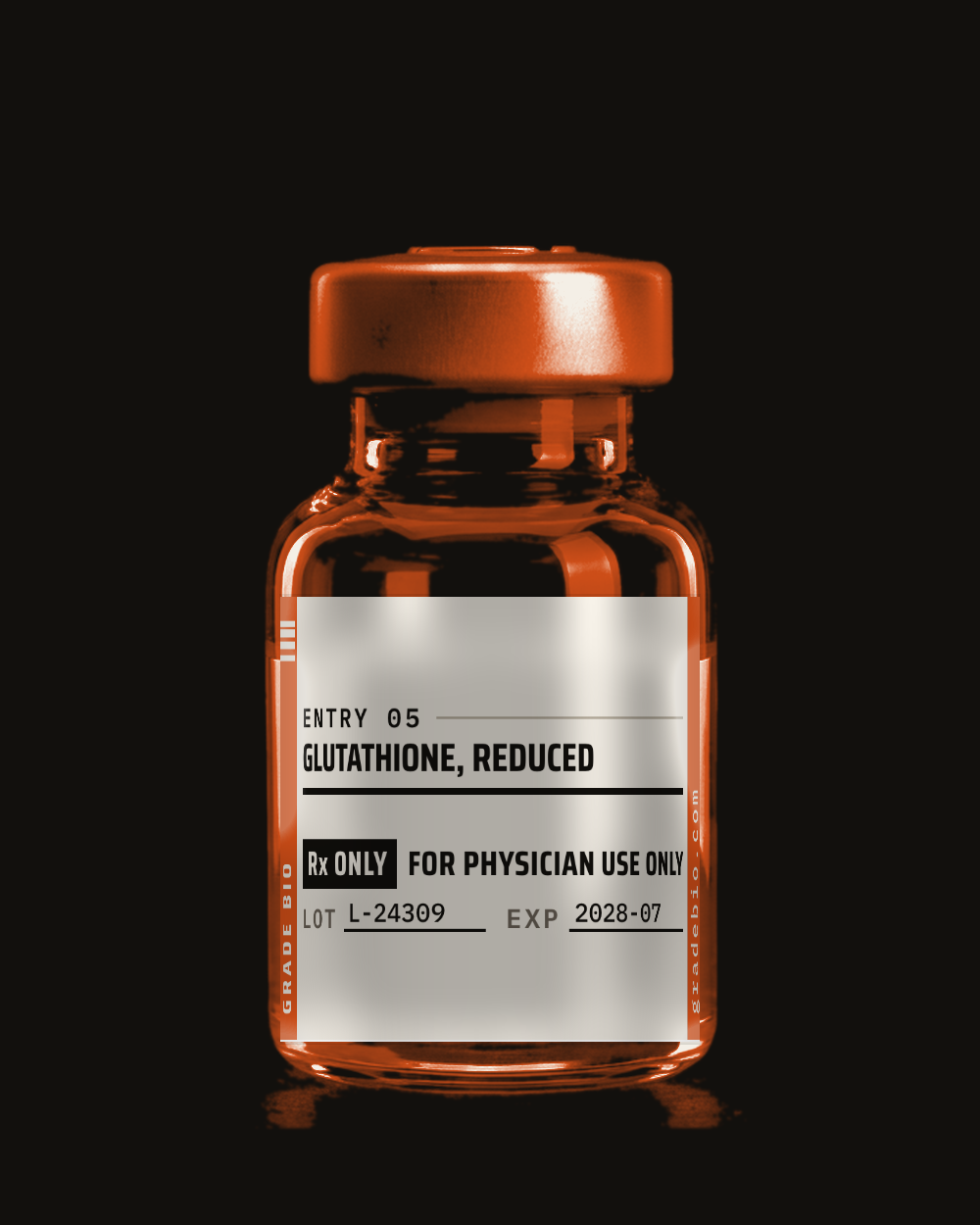
Grade Bio / Register / Entry 05 / Sheet G‑03.05
What this is
Reduced glutathione is a tripeptide, and the bond that makes it unusual is the one at the glutamate end: a gamma linkage through the side chain rather than the alpha carboxyl.
That gamma bond is why the molecule resists ordinary peptidases, and it is also why the identity test is a chromatographic comparison against a reference rather than a residue count. Two tripeptides can share a formula and a mass and not share that linkage.
The free thiol at the cysteine is the reactive part. It oxidizes to the disulfide dimer, GSSG, in the presence of air and metal ions, which is why the fill is sealed under nitrogen and why the oxidized fraction has a line of its own in table 2.1.
Specification
Every attribute has a method behind it and a number the lot has to reach before it leaves. The result column shows specimen lot L‑24417. A lot that misses a single line is not released, and the register entry is marked rather than the sheet edited.
| Attribute | Method | Specification | Result |
|---|---|---|---|
| Appearance | Visual | Clear, colorless to pale yellow | Conforms |
| Identity, retention | RP‑HPLC vs reference | Conforms | Conforms |
| Identity, structure | ATR‑FTIR | Conforms to reference | Conforms |
| Assay, reduced glutathione | RP‑HPLC | ≥ 99.0 % of label | 99.6 % |
| Oxidized glutathione, GSSG | RP‑HPLC, area % | ≤ 1.0 % | 0.18 % |
| Related substances, total | RP‑HPLC, area % | ≤ 1.0 % | 0.31 % |
| pH | Potentiometric, 25 °C | 4.5 to 6.5 | 5.4 |
| Osmolality | Freezing point depression | Report result | 712 mOsm/kg |
| Elemental impurities | ICP‑MS | Per ICH Q3D | Conforms |
| Particulate matter | Light obscuration | Per USP <788> | Conforms |
| Bacterial endotoxin | LAL, kinetic chromogenic | ≤ 0.5 EU/mg | < 0.05 EU/mg |
| Sterility | Membrane filtration, 14 day | Sterile | Sterile |
| Container closure integrity | Dye ingress | No ingress | Conforms |
| Fill volume | Gravimetric | ≥ 10.0 mL | 10.3 mL |
Storage and retention
Documents behind this lot
| Document | No. | What it shows |
|---|---|---|
| Certificate of analysis | GB‑101 | Every attribute in table 2.1, the method, the specification and the measured result, signed on release. |
| Identity data package | GB‑104 | The reference chromatogram and the infrared spectrum the lot was compared against, with the GSSG peak identified and integrated. |
| Method summary | GB‑110 | The analytical methods named in table 2.1, with their validation state. |
| Stability summary | GB‑118 | The data the storage condition and the retest period rest on. |
| Lot genealogy | GB‑140 | Raw material lot, fill date, container closure lot, and the release signature. |
How it reaches a patient
Grade Bio does not dispense and does not ship to a patient. Material is supplied only pursuant to a valid prescription for an individually identified patient, and it is dispensed by the licensed pharmacy of record named on the account. The practitioner writes the prescription. The pharmacy fills it. We supply the material and the paperwork that proves what it is. Sheet G‑07 sets out the whole route.
Grade Bio is a brand of Mountain Brands LLC. Entity formation is pending and no registration has been filed. Correspondence to jv@gradebio.com or sw@gradebio.com.
Pre‑launch document Entity pending